


Page 78 - Communication across Cultures
P. 78
Communication across Cultures


                 Olfaction (smell): Olfaction allows us to perceive and interpret different odors. The
             olfactory receptors in our nose detect chemical molecules in the air, and these signals
             are sent to the brain, allowing us to identify and discriminate between various smells.
                 Gustation (taste): Gustation refers to the sense of taste, allowing us to perceive
             and interpret different flavors. Taste buds on the tongue and other parts of the mouth
             detect chemical molecules in food and beverages, sending signals to the brain that en-
             able us to perceive sweet, sour, salty, bitter, and umami tastes.

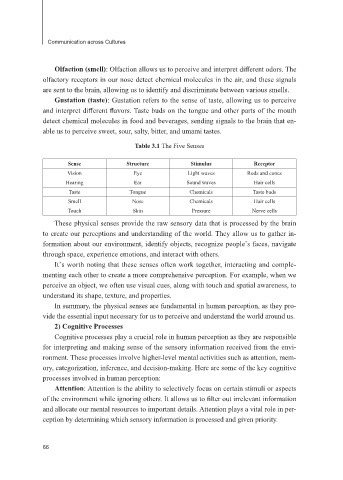
                                        Table 3.1 The Five Senses

                     Sense            Structure         Stimulus           Receptor
                     Vision             Eye             Light waves      Rods and cones
                    Hearing             Ear            Sound waves         Hair cells
                     Taste             Tongue           Chemicals          Taste buds
                     Smell             Nose             Chemicals          Hair cells
                     Touch              Skin             Pressure         Nerve cells
                 These physical senses provide the raw sensory data that is processed by the brain
             to create our perceptions and understanding of the world. They allow us to gather in-
             formation about our environment, identify objects, recognize people’s faces, navigate
             through space, experience emotions, and interact with others.
                 It’s worth noting that these senses often work together, interacting and comple-
             menting each other to create a more comprehensive perception. For example, when we
             perceive an object, we often use visual cues, along with touch and spatial awareness, to
             understand its shape, texture, and properties.
                 In summary, the physical senses are fundamental in human perception, as they pro-
             vide the essential input necessary for us to perceive and understand the world around us.
                 2) Cognitive Processes
                 Cognitive processes play a crucial role in human perception as they are responsible
             for interpreting and making sense of the sensory information received from the envi-
             ronment. These processes involve higher-level mental activities such as attention, mem-
             ory, categorization, inference, and decision-making. Here are some of the key cognitive
             processes involved in human perception:
                 Attention: Attention is the ability to selectively focus on certain stimuli or aspects
             of the environment while ignoring others. It allows us to filter out irrelevant information
             and allocate our mental resources to important details. Attention plays a vital role in per-
             ception by determining which sensory information is processed and given priority.


             66

