


Page 207 - Feasibility Study of New Media Technology on Constructing Online Public Sphere
P. 207
Chapter 7. The Yihuang incident


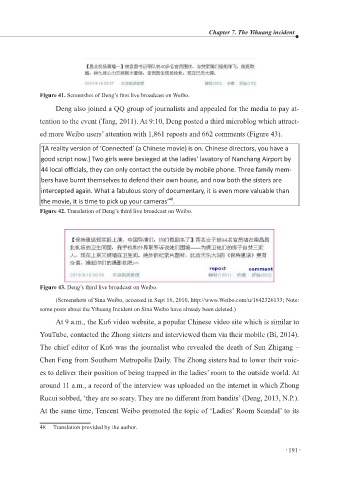
            Figure 41. Screenshot of Deng’s first live broadcast on Weibo.
                 Deng also joined a QQ group of journalists and appealed for the media to pay at-
            tention to the event (Tang, 2011). At 9:10, Deng posted a third microblog which attract-

            ed more Weibo users’ attention with 1,861 reposts and 662 comments (Figure 43).
             ‘[A reality version of ‘Connected’ (a Chinese movie) is on. Chinese directors, you have a
             good script now.] Two girls were besieged at the ladies’ lavatory of Nanchang Airport by
             44 local officials, they can only contact the outside by mobile phone. Three family mem-
             bers have burnt themselves to defend their own house, and now both the sisters are
             intercepted again. What a fabulous story of documentary, it is even more valuable than
                                                 48
             the movie, it is time to pick up your cameras’ .
            Figure 42. Translation of Deng’s third live broadcast on Weibo.


            Figure 43. Deng’s third live broadcast on Weibo.
                 (Screenshots of Sina Weibo, accessed in Sept 16, 2010, http://www.Weibo.com/u/1642326133; Note:
            some posts about the Yihuang Incident on Sina Weibo have already been deleted.)
                 At 9 a.m., the Ku6 video website, a popular Chinese video site which is similar to
            YouTube, contacted the Zhong sisters and interviewed them via their mobile (Bi, 2014).

            The chief editor of Ku6 was the journalist who revealed the death of Sun Zhigang –
            Chen Feng from Southern Metropolis Daily. The Zhong sisters had to lower their voic-
            es to deliver their position of being trapped in the ladies’ room to the outside world. At
            around 11 a.m., a record of the interview was uploaded on the internet in which Zhong

            Rucui sobbed, ‘they are so scary. They are no different from bandits’ (Deng, 2013, N.P.).
            At the same time, Tencent Weibo promoted the topic of ‘Ladies’ Room Scandal’ to its

            48  Translation provided by the author.


                                                                                    191
                                                                                    191

