


Page 215 - Feasibility Study of New Media Technology on Constructing Online Public Sphere
P. 215
Chapter 7. The Yihuang incident


            lighted the phenomenon and explained that, ‘the advent of the internet makes it possi-

            ble for people to make a direct voice, not something passed on by the third-person. It
                                          53
            is a huge progress’ (Interviewee 6) . It is acknowledged by his peer as well, ‘internet
            provides a channel, a medium, a platform and most importantly, a bridge for message
                                                 54
            to be delivered to the target’ (Interviewee 3) .


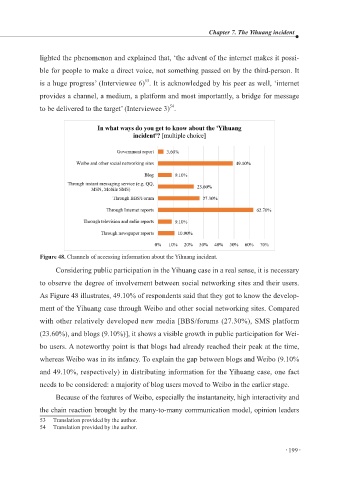
            Figure 48. Channels of accessing information about the Yihuang incident.
                 Considering public participation in the Yihuang case in a real sense, it is necessary
            to observe the degree of involvement between social networking sites and their users.
            As Figure 48 illustrates, 49.10% of respondents said that they got to know the develop-

            ment of the Yihuang case through Weibo and other social networking sites. Compared
            with other relatively developed new media [BBS/forums (27.30%), SMS platform
            (23.60%), and blogs (9.10%)], it shows a visible growth in public participation for Wei-
            bo users. A noteworthy point is that blogs had already reached their peak at the time,

            whereas Weibo was in its infancy. To explain the gap between blogs and Weibo (9.10%
            and 49.10%, respectively) in distributing information for the Yihuang case, one fact
            needs to be considered: a majority of blog users moved to Weibo in the earlier stage.
                 Because of the features of Weibo, especially the instantaneity, high interactivity and

            the chain reaction brought by the many-to-many communication model, opinion leaders
            53  Translation provided by the author.
            54  Translation provided by the author.


                                                                                    199
                                                                                    199

