


Page 93 - Communication across Cultures
P. 93
Chapter 3 Culture’s Influence on Perception


               and how they interpret sensory information. For example, cultural norms and values
               may affect what is considered important or relevant to perceive in a given situation. Ad-
               ditionally, cultural practices and experiences can shape individuals’ sensory preferences
               and sensitivities. For instance, certain cultures may value visual aesthetics more than
               others, leading individuals to focus more on visual stimuli.
                  Moreover, cultural groups often develop their own unique sets of perceptual biases,
               influencing how they interpret and make sense of incoming information. These biases
               can extend to various domains, including language, face perception, spatial perception,
               and even time perception. Culture can shape individuals’ attentional focus, perceptual
               categorization, and interpretation of social cues.
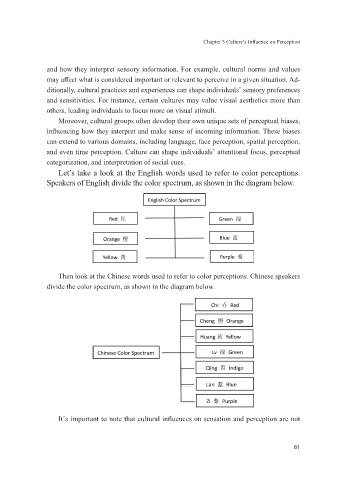
                  Let’s take a look at the English words used to refer to color perceptions.
               Speakers of English divide the color spectrum, as shown in the diagram below.


                  Then look at the Chinese words used to refer to color perceptions. Chinese speakers
               divide the color spectrum, as shown in the diagram below.


                  It’s important to note that cultural influences on sensation and perception are not


                                                                                       81

