


Page 97 - Feasibility Study of New Media Technology on Constructing Online Public Sphere
P. 97
Chapter 4. Methodology


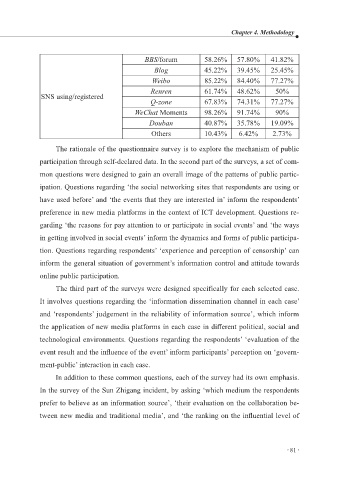
                                          BBS/forum        58.26%   57.80%    41.82%
                                             Blog          45.22%   39.45%    25.45%
                                            Weibo          85.22%   84.40%    77.27%
                                            Renren         61.74%   48.62%     50%
             SNS using/registered
                                            Q-zone         67.83%   74.31%    77.27%
                                       WeChat Moments      98.26%   91.74%     90%
                                           Douban          40.87%   35.78%    19.09%
                                            Others         10.43%    6.42%    2.73%
                 The rationale of the questionnaire survey is to explore the mechanism of public

            participation through self-declared data. In the second part of the surveys, a set of com-
            mon questions were designed to gain an overall image of the patterns of public partic-
            ipation. Questions regarding ‘the social networking sites that respondents are using or
            have used before’ and ‘the events that they are interested in’ inform the respondents’

            preference in new media platforms in the context of ICT development. Questions re-
            garding ‘the reasons for pay attention to or participate in social events’ and ‘the ways
            in getting involved in social events’ inform the dynamics and forms of public participa-
            tion. Questions regarding respondents’ ‘experience and perception of censorship’ can

            inform the general situation of government’s information control and attitude towards
            online public participation.
                 The third part of the surveys were designed specifically for each selected case.
            It involves questions regarding the ‘information dissemination channel in each case’

            and ‘respondents’ judgement in the reliability of information source’, which inform
            the application of new media platforms in each case in different political, social and
            technological environments. Questions regarding the respondents’ ‘evaluation of the
            event result and the influence of the event’ inform participants’ perception on ‘govern-

            ment-public’ interaction in each case.
                 In addition to these common questions, each of the survey had its own emphasis.
            In the survey of the Sun Zhigang incident, by asking ‘which medium the respondents
            prefer to believe as an information source’, ‘their evaluation on the collaboration be-

            tween new media and traditional media’, and ‘the ranking on the influential level of


                                                                                    81
                                                                                    81

