


Page 17 - Communication across Cultures
P. 17
Chapter 1 Culture


               sustenance, and survival.
                  Similar to how different bodies of water can have different characteristics, each cul-
               ture has its own unique attributes, values, and norms. These cultural contexts shape our
               worldview and inform our understanding of the world around us.
                  Like a fish swimming in water, individuals are immersed in their cultural context
               from birth. They are influenced by the beliefs, customs, traditions, and social norms
               prevalent in their society. These cultural influences become the lens through which in-
               dividuals perceive and interpret their experiences.
                  Additionally, just as fish may not be aware of the water they swim in, individuals
               are often not fully conscious of the extent to which culture shapes their thoughts and
               behaviors. It becomes a part of their subconscious, influencing their choices and actions
               without conscious awareness.
                  Understanding culture as the water in which we swim helps us appreciate its per-
               vasive influence and recognize the need for cross-cultural awareness and sensitivity.
               By recognizing the role of culture in shaping our experiences and perspectives, we can
               foster greater empathy, understanding, and respect for cultural diversity.
               1.1.4 Culture Is the Grammar of Our Behavior

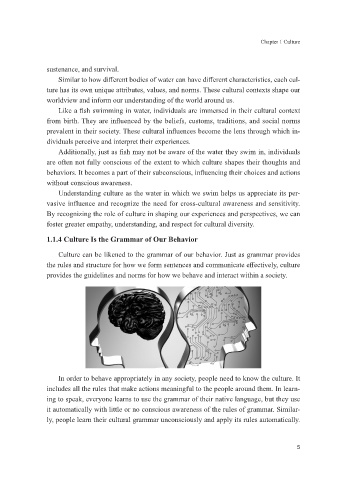
                  Culture can be likened to the grammar of our behavior. Just as grammar provides
               the rules and structure for how we form sentences and communicate effectively, culture
               provides the guidelines and norms for how we behave and interact within a society.


                  In order to behave appropriately in any society, people need to know the culture. It
               includes all the rules that make actions meaningful to the people around them. In learn-
               ing to speak, everyone learns to use the grammar of their native language, but they use
               it automatically with little or no conscious awareness of the rules of grammar. Similar-
               ly, people learn their cultural grammar unconsciously and apply its rules automatically.


                                                                                       5

