


Page 15 - Communication across Cultures
P. 15
Chapter 1 Culture


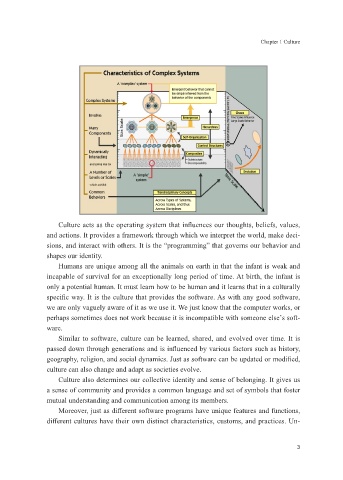
                  Culture acts as the operating system that influences our thoughts, beliefs, values,
               and actions. It provides a framework through which we interpret the world, make deci-
               sions, and interact with others. It is the “programming” that governs our behavior and
               shapes our identity.
                  Humans are unique among all the animals on earth in that the infant is weak and
               incapable of survival for an exceptionally long period of time. At birth, the infant is
               only a potential human. It must learn how to be human and it learns that in a culturally
               specific way. It is the culture that provides the software. As with any good software,
               we are only vaguely aware of it as we use it. We just know that the computer works, or
               perhaps sometimes does not work because it is incompatible with someone else’s soft-
               ware.
                  Similar to software, culture can be learned, shared, and evolved over time. It is
               passed down through generations and is influenced by various factors such as history,
               geography, religion, and social dynamics. Just as software can be updated or modified,
               culture can also change and adapt as societies evolve.
                  Culture also determines our collective identity and sense of belonging. It gives us
               a sense of community and provides a common language and set of symbols that foster
               mutual understanding and communication among its members.
                  Moreover, just as different software programs have unique features and functions,
               different cultures have their own distinct characteristics, customs, and practices. Un-


                                                                                       3

