


Page 14 - Communication across Cultures
P. 14
Communication across Cultures


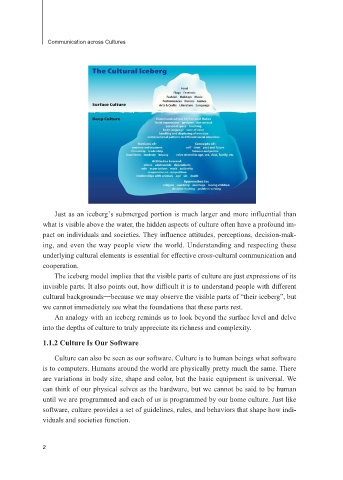
                 Just as an iceberg’s submerged portion is much larger and more influential than
             what is visible above the water, the hidden aspects of culture often have a profound im-
             pact on individuals and societies. They influence attitudes, perceptions, decision-mak-
             ing, and even the way people view the world. Understanding and respecting these
             underlying cultural elements is essential for effective cross-cultural communication and
             cooperation.
                 The iceberg model implies that the visible parts of culture are just expressions of its
             invisible parts. It also points out, how difficult it is to understand people with different
             cultural backgrounds—because we may observe the visible parts of “their iceberg”, but
             we cannot immediately see what the foundations that these parts rest.
                 An analogy with an iceberg reminds us to look beyond the surface level and delve
             into the depths of culture to truly appreciate its richness and complexity.

             1.1.2 Culture Is Our Software

                 Culture can also be seen as our software. Culture is to human beings what software
             is to computers. Humans around the world are physically pretty much the same. There
             are variations in body size, shape and color, but the basic equipment is universal. We
             can think of our physical selves as the hardware, but we cannot be said to be human
             until we are programmed and each of us is programmed by our home culture. Just like
             software, culture provides a set of guidelines, rules, and behaviors that shape how indi-
             viduals and societies function.


             2

