


Page 191 - Communication across Cultures
P. 191
Chapter 6 Non-Verbal Communication


               discussions.
                  Social distance: This zone extends from about 4 to 12 feet (1.2 to 3.7 meters) and
               is suitable for formal or professional interactions. It is often maintained in settings like
               business meetings, classrooms, or public events.
                  Public distance: The outermost zone, ranging from about 12 feet (3.7 meters) and
               beyond, is typically used for public speaking or situations where the individual’s rela-
               tionship with others is primarily impersonal or formal.

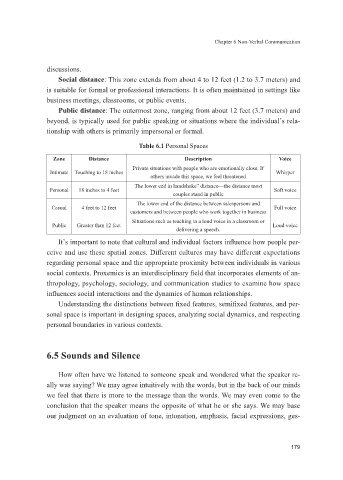
                                         Table 6.1 Personal Spaces
                Zone       Distance                    Description                Voice
                                        Private situations with people who are emotionally close. If
                Intimate  Touching to 18 inches                                  Whisper
                                             others invade this space, we feel threatened
                                        The lower end in handshake” distance—the distance most
               Personal   18 inches to 4 feet                                    Soft voice
                                                   couples stand in public
                                         The lower end of the distance between salespersons and
                Casual   4 feet to 12 feet                                       Full voice
                                       customers and between people who work together in business
                                       Situations such as teaching in a loud voice in a classroom or
                Public   Greater than 12 feet                                   Loud voice
                                                    delivering a speech.
                  It’s important to note that cultural and individual factors influence how people per-
               ceive and use these spatial zones. Different cultures may have different expectations
               regarding personal space and the appropriate proximity between individuals in various
               social contexts. Proxemics is an interdisciplinary field that incorporates elements of an-
               thropology, psychology, sociology, and communication studies to examine how space
               influences social interactions and the dynamics of human relationships.
                  Understanding the distinctions between fixed features, semifixed features, and per-
               sonal space is important in designing spaces, analyzing social dynamics, and respecting
               personal boundaries in various contexts.


               6.5 Sounds and Silence


                  How often have we listened to someone speak and wondered what the speaker re-
               ally was saying? We may agree intuitively with the words, but in the back of our minds
               we feel that there is more to the message than the words. We may even come to the
               conclusion that the speaker means the opposite of what he or she says. We may base
               our judgment on an evaluation of tone, intonation, emphasis, facial expressions, ges-


                                                                                      179

