


Page 171 - Feasibility Study of New Media Technology on Constructing Online Public Sphere
P. 171
Chapter 6. The Xiamen PX plant event


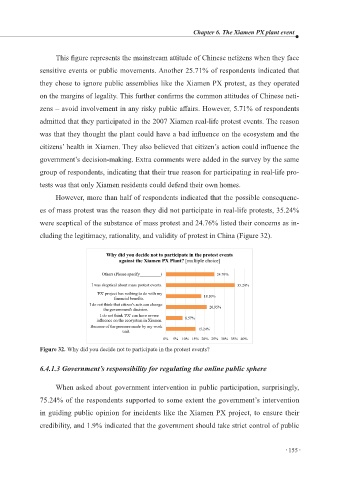
                 This figure represents the mainstream attitude of Chinese netizens when they face

            sensitive events or public movements. Another 25.71% of respondents indicated that
            they chose to ignore public assemblies like the Xiamen PX protest, as they operated
            on the margins of legality. This further confirms the common attitudes of Chinese neti-
            zens – avoid involvement in any risky public affairs. However, 5.71% of respondents
            admitted that they participated in the 2007 Xiamen real-life protest events. The reason

            was that they thought the plant could have a bad influence on the ecosystem and the
            citizens’ health in Xiamen. They also believed that citizen’s action could influence the
            government’s decision-making. Extra comments were added in the survey by the same

            group of respondents, indicating that their true reason for participating in real-life pro-
            tests was that only Xiamen residents could defend their own homes.
                 However, more than half of respondents indicated that the possible consequenc-
            es of mass protest was the reason they did not participate in real-life protests, 35.24%
            were sceptical of the substance of mass protest and 24.76% listed their concerns as in-

            cluding the legitimacy, rationality, and validity of protest in China (Figure 32).


            Figure 32. Why did you decide not to participate in the protest events?

            6.4.1.3 Government’s responsibility for regulating the online public sphere


                 When asked about government intervention in public participation, surprisingly,
            75.24% of the respondents supported to some extent the government’s intervention
            in guiding public opinion for incidents like the Xiamen PX project, to ensure their
            credibility, and 1.9% indicated that the government should take strict control of public


                                                                                    155
                                                                                    155

