


Page 172 - Feasibility Study of New Media Technology on Constructing Online Public Sphere
P. 172
Feasibility Study of New Media Technology
               on Constructing Online Public Sphere


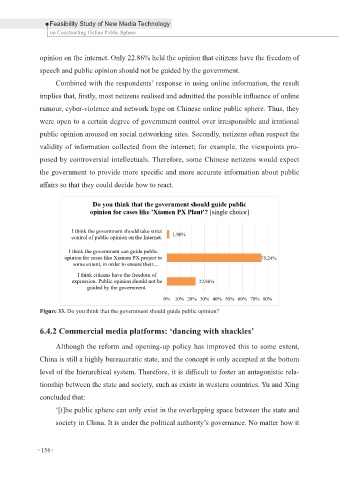
            opinion on the internet. Only 22.86% held the opinion that citizens have the freedom of

            speech and public opinion should not be guided by the government.
                 Combined with the respondents’ response in using online information, the result
            implies that, firstly, most netizens realised and admitted the possible influence of online
            rumour, cyber-violence and network hype on Chinese online public sphere. Thus, they
            were open to a certain degree of government control over irresponsible and irrational

            public opinion aroused on social networking sites. Secondly, netizens often suspect the
            validity of information collected from the internet; for example, the viewpoints pro-
            posed by controversial intellectuals. Therefore, some Chinese netizens would expect

            the government to provide more specific and more accurate information about public
            affairs so that they could decide how to react.


            Figure 33. Do you think that the government should guide public opinion?


            6.4.2 Commercial media platforms: ‘dancing with shackles’
                 Although the reform and opening-up policy has improved this to some extent,

            China is still a highly bureaucratic state, and the concept is only accepted at the bottom
            level of the hierarchical system. Therefore, it is difficult to foster an antagonistic rela-
            tionship between the state and society, such as exists in western countries. Yu and Xing
            concluded that:

                 ‘[t]he public sphere can only exist in the overlapping space between the state and
                 society in China. It is under the political authority’s governance. No matter how it


             156
             156

