


Page 11 - Communication across Cultures
P. 11
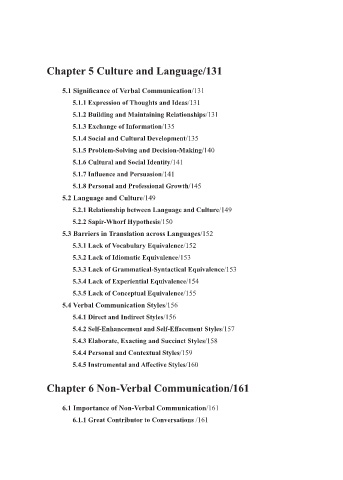
Chapter 5 Culture and Language/131


                   5.1 Significance of Verbal Communication/131
                      5.1.1 Expression of Thoughts and Ideas/131
                      5.1.2 Building and Maintaining Relationships/131
                      5.1.3 Exchange of Information/135
                      5.1.4 Social and Cultural Development/135
                      5.1.5 Problem-Solving and Decision-Making/140
                      5.1.6 Cultural and Social Identity/141

                      5.1.7 Influence and Persuasion/141
                      5.1.8 Personal and Professional Growth/145
                   5.2 Language and Culture/149
                      5.2.1 Relationship between Language and Culture/149
                      5.2.2 Sapir-Whorf Hypothesis/150

                   5.3 Barriers in Translation across Languages/152
                      5.3.1 Lack of Vocabulary Equivalence/152
                      5.3.2 Lack of Idiomatic Equivalence/153
                      5.3.3 Lack of Grammatical-Syntactical Equivalence/153
                      5.3.4 Lack of Experiential Equivalence/154
                      5.3.5 Lack of Conceptual Equivalence/155
                   5.4 Verbal Communication Styles/156

                      5.4.1 Direct and Indirect Styles/156
                      5.4.2 Self-Enhancement and Self-Effacement Styles/157
                      5.4.3 Elaborate, Exacting and Succinct Styles/158
                      5.4.4 Personal and Contextual Styles/159
                      5.4.5 Instrumental and Affective Styles/160


               Chapter 6 Non-Verbal Communication/161


                   6.1 Importance of Non-Verbal Communication/161
                      6.1.1 Great Contributor to Conversations /161

