


Page 37 - Research on Financial Development Mechanism and Path of Forestry Carbon Sequestration in Developing Countries under Double Carbon Targets
P. 37
Chapter 1 Carbon Asset Management Practice


               upstream of the system boundary is the production stage of raw materials and energy
               mining, the core process is the processing and production stage of industrial products,
               and the downstream is the recycling stage of by-products and products after they are
               abandoned. According to the provisions of ISO14067, the system boundary can be
               divided into cradle-to-gate (upstream+core), cradle-to-grave (upstream+core+down-
               stream), gate-to-gate (core) and partially customized carbon footprint boundary, among
               which the gate-to-gate boundary division model is more suitable for organizing carbon
               footprint assessment.

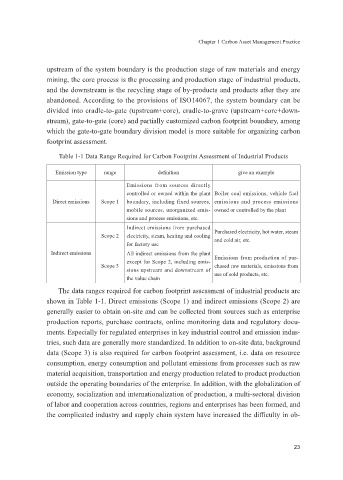
                  Table 1-1 Data Range Required for Carbon Footprint Assessment of Industrial Products

                 Emission type  range          definition             give an example
                                      Emissions  from  sources  directly
                                      controlled or owned within the plant  Boiler coal emissions, vehicle fuel
                Direct emissions  Scope 1  boundary, including fixed sources,  emissions and process emissions
                                      mobile sources, unorganized emis- owned or controlled by the plant
                                      sions and process emissions, etc.
                                      Indirect emissions from purchased
                              Scope 2  electricity, steam, heating and cooling   Purchased electricity, hot water, steam
                                                               and cold air, etc.
                                      for factory use
                Indirect emissions    All indirect emissions from the plant
                                      except for Scope 2, including emis-  Emissions from production of pur-
                              Scope 3                          chased raw materials, emissions from
                                      sions upstream and downstream of   use of sold products, etc.
                                      the value chain
                  The data ranges required for carbon footprint assessment of industrial products are
               shown in Table 1-1. Direct emissions (Scope 1) and indirect emissions (Scope 2) are
               generally easier to obtain on-site and can be collected from sources such as enterprise
               production reports, purchase contracts, online monitoring data and regulatory docu-
               ments. Especially for regulated enterprises in key industrial control and emission indus-
               tries, such data are generally more standardized. In addition to on-site data, background
               data (Scope 3) is also required for carbon footprint assessment, i.e. data on resource
               consumption, energy consumption and pollutant emissions from processes such as raw
               material acquisition, transportation and energy production related to product production
               outside the operating boundaries of the enterprise. In addition, with the globalization of
               economy, socialization and internationalization of production, a multi-sectoral division
               of labor and cooperation across countries, regions and enterprises has been formed, and
               the complicated industry and supply chain system have increased the difficulty in ob-


                                                                                       23

