


Page 143 - Feasibility Study of New Media Technology on Constructing Online Public Sphere
P. 143
Chapter 5. The Sun Zhigang incident


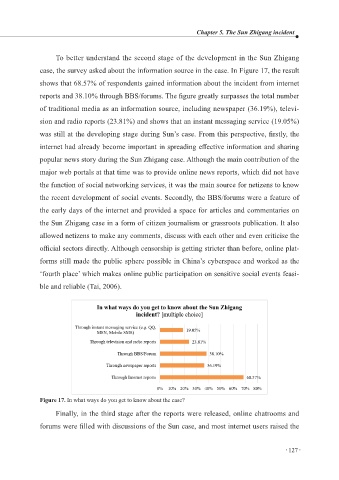
                 To better understand the second stage of the development in the Sun Zhigang

            case, the survey asked about the information source in the case. In Figure 17, the result
            shows that 68.57% of respondents gained information about the incident from internet
            reports and 38.10% through BBS/forums. The figure greatly surpasses the total number
            of traditional media as an information source, including newspaper (36.19%), televi-
            sion and radio reports (23.81%) and shows that an instant messaging service (19.05%)

            was still at the developing stage during Sun’s case. From this perspective, firstly, the
            internet had already become important in spreading effective information and sharing
            popular news story during the Sun Zhigang case. Although the main contribution of the

            major web portals at that time was to provide online news reports, which did not have
            the function of social networking services, it was the main source for netizens to know
            the recent development of social events. Secondly, the BBS/forums were a feature of
            the early days of the internet and provided a space for articles and commentaries on
            the Sun Zhigang case in a form of citizen journalism or grassroots publication. It also

            allowed netizens to make any comments, discuss with each other and even criticise the
            official sectors directly. Although censorship is getting stricter than before, online plat-
            forms still made the public sphere possible in China’s cyberspace and worked as the

            ‘fourth place’ which makes online public participation on sensitive social events feasi-
            ble and reliable (Tai, 2006).


            Figure 17. In what ways do you get to know about the case?
                 Finally, in the third stage after the reports were released, online chatrooms and
            forums were filled with discussions of the Sun case, and most internet users raised the


                                                                                    127
                                                                                    127

