


Page 147 - Feasibility Study of New Media Technology on Constructing Online Public Sphere
P. 147
Chapter 5. The Sun Zhigang incident


            day’s cyberspace. Although technological development has empowered easy access to

            information exchange and online public opinions can be formed more efficiently than
            before, government officials only pay attention to the hotly debated issues. The current
            situation is that any kind of overly-sensitive or anti-Party public participation will be
            censored or deleted in the very early stage without any negotiation, which represents
            the bottom line for such a centralism state like China.


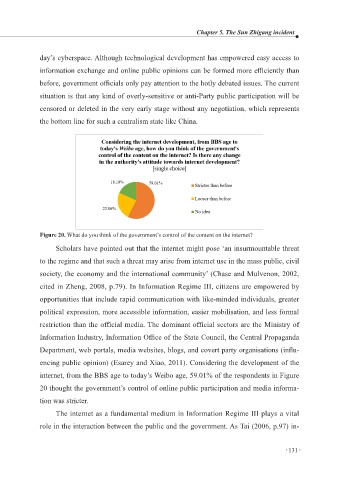
            Figure 20. What do you think of the government’s control of the content on the internet?
                 Scholars have pointed out that the internet might pose ‘an insurmountable threat
            to the regime and that such a threat may arise from internet use in the mass public, civil

            society, the economy and the international community’ (Chase and Mulvenon, 2002,
            cited in Zheng, 2008, p.79). In Information Regime III, citizens are empowered by
            opportunities that include rapid communication with like-minded individuals, greater
            political expression, more accessible information, easier mobilisation, and less formal
            restriction than the official media. The dominant official sectors are the Ministry of

            Information Industry, Information Office of the State Council, the Central Propaganda
            Department, web portals, media websites, blogs, and covert party organisations (influ-
            encing public opinion) (Esarey and Xiao, 2011). Considering the development of the

            internet, from the BBS age to today’s Weibo age, 59.01% of the respondents in Figure
            20 thought the government’s control of online public participation and media informa-
            tion was stricter.
                 The internet as a fundamental medium in Information Regime III plays a vital
            role in the interaction between the public and the government. As Tai (2006, p.97) in-


                                                                                    131
                                                                                    131

