


Page 111 - Illustrated Chen Taijiquan Routine Ⅱ (Cannon Fist)
P. 111
IV. Postures of Chen Taijiquan Routine II (Cannon Fist)


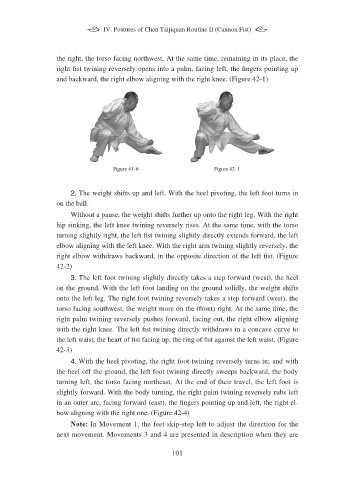
                 the right, the torso facing northwest. At the same time, remaining in its place, the
                 right fist twining reversely opens into a palm, facing left, the fingers pointing up
                 and backward, the right elbow aligning with the right knee. (Figure 42-1)


                                  Figure 41-6                  Figure 42-1


                      2. The weight shifts up and left. With the heel pivoting, the left foot turns in
                 on the ball.
                      Without a pause, the weight shifts further up onto the right leg. With the right
                 hip sinking, the left knee twining reversely rises. At the same time, with the torso
                 turning slightly right, the left fist twining slightly directly extends forward, the left
                 elbow aligning with the left knee. With the right arm twining slightly reversely, the
                 right elbow withdraws backward, in the opposite direction of the left fist. (Figure
                 42-2)
                      3. The left foot twining slightly directly takes a step forward (west), the heel
                 on the ground. With the left foot landing on the ground solidly, the weight shifts
                 onto the left leg. The right foot twining reversely takes a step forward (west), the
                 torso facing southwest, the weight more on the (front) right. At the same time, the
                 right palm twining reversely pushes forward, facing out, the right elbow aligning
                 with the right knee. The left fist twining directly withdraws in a concave curve to
                 the left waist, the heart of fist facing up, the ring of fist against the left waist. (Figure
                 42-3)
                      4. With the heel pivoting, the right foot twining reversely turns in; and with
                 the heel off the ground, the left foot twining directly sweeps backward, the body
                 turning left, the torso facing northeast. At the end of their travel, the left foot is
                 slightly forward. With the body turning, the right palm twining reversely rubs left
                 in an outer arc, facing forward (east), the fingers pointing up and left, the right el-
                 bow aligning with the right one. (Figure 42-4)
                      Note: In Movement 1, the feet skip-step left to adjust the direction for the
                 next movement. Movements 3 and 4 are presented in description when they are

                                                   101

