


Page 32 - 先天性心脏病的导管术:从婴幼儿期到成人期
P. 32
14 先天性心脏病的导管术:从婴幼儿期到成人期
考虑这一并发症并及时干预。治疗包括静脉注射类固醇、应用利尿剂,偶尔需要在手
术后进行无创通气(持续气道正压通气,CPAP)数小时。
血管内血栓形成可能发生在导管手术后,通常与已确定的患者相关的危险因素(即
新生儿,小婴儿)有关,可能需要肝素或纤溶治疗。在极少数情况下,需要进行血管
外科介入手术。
急性肾功能衰竭(ARF)是另一重要并发症,特别是在那些接受导管室手术和外
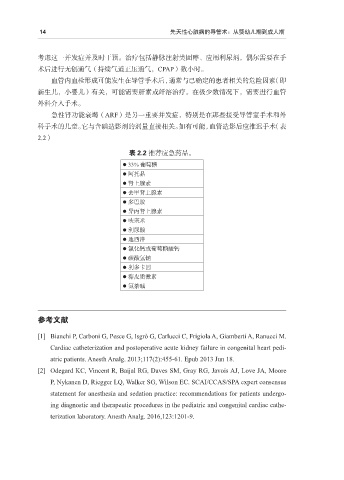
科手术的儿童。它与含碘造影剂的剂量直接相关。如有可能,血管造影后应推迟手术(表
2.2)
表 2.2 推荐应急药品。
33% 葡萄糖
阿托品
肾上腺素
去甲肾上腺素
多巴胺
异丙肾上腺素
呋塞米
利尿酸
地西泮
氯化钙或葡萄糖酸钙
碳酸氢钠
利多卡因
糖皮质激素
氨茶碱
参考文献
[1] Bianchi P, Carboni G, Pesce G, Isgrò G, Carlucci C, Frigiola A, Giamberti A, Ranucci M.
Cardiac catheterization and postoperative acute kidney failure in congenital heart pedi-
atric patients. Anesth Analg. 2013;117(2):455-61. Epub 2013 Jun 18.
[2] Odegard KC, Vincent R, Baijal RG, Daves SM, Gray RG, Javois AJ, Love JA, Moore
P, Nykanen D, Riegger LQ, Walker SG, Wilson EC. SCAI/CCAS/SPA expert consensus
statement for anesthesia and sedation practice: recommendations for patients undergo-
ing diagnostic and therapeutic procedures in the pediatric and congenital cardiac cathe-
terization laboratory. Anesth Analg. 2016,123:1201-9.

