


Page 139 - 先天性心脏病的导管术:从婴幼儿期到成人期
P. 139
11  Hemodynamic Assessment: Pressures, Flow, Resistances…
                                                                                 175
                               11.7   Pulmonary Vascular Reactivity Testing
                               The assessment of pulmonary vascular reactivity plays an impor-
                               tant role in the management and assessment of pulmonary hyper-
                               tension. Following baseline hemodynamic assessment, the patient
                               is exposed to 100% oxygen (for a minimum of 10 min) and repeat
                               saturations and pressure measurements. When enriched oxygen is
                               administered  (F I O 2   >  30%),  the  dissolved  oxygen  must  be
                               accounted for in the calculation. Failure to do so will underesti-
                               mate of PVR. Situations that can increase PVR include hypoxia,
                               hypercapnia, erythrocytosis, increased sympathetic tone pulmo-
                               nary  emboli,  precapillary  pulmonary  edema,  lung  compression
                               (pleural effusion), mechanical ventilation, and positive intratho-
                    11 血液动力学评估:压力,流速,阻力和血管反应性实验                                               121
                               racic  pressure.  Common  errors  in  PVR  assessment  include
                               hypoventilation and acidosis producing pulmonary vasoconstric-
                               tion, failure to calculate dissolved O 2 , and underestimate AV O 2
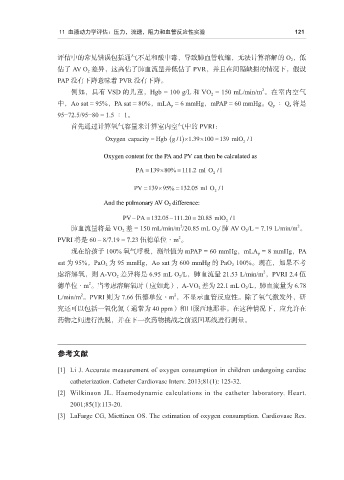
                   评估中的常见错误包括通气不足和酸中毒,导致肺血管收缩,无法计算溶解的 O 2 ,低
                               difference which overestimates pulmonary blood flow and under-
                   估了 AV O 2 差异,这高估了肺血流量并低估了 PVR,并且在间隔缺损的情况下,假设
                               estimates PVR, and in the setting of a septal defect assuming that
                               no fall in PAP means no fall in PVR.
                   PAP 没有下降意味着 PVR 没有下降。
                                  For  example,  a  child  with  a  VSD,  Hgb  =  100  g/l  and
                                                                                    2
                       例如,具有 VSD 的儿童,Hgb = 100 g/L 和 VO 2  = 150 mL/min/m 。在室内空气
                               VO 2  = 150 ml/min/m . In room air, Ao sat = 95%, PA sat = 80%,
                                                2
                               mLA p  = 6 mmHg, and mPAP = 60 mmHg.
                   中,Ao sat = 95%,PA sat = 80%,mLA p  = 6 mmHg,mPAP = 60 mmHg。Q p ∶ Q s 将是
                                  The Q p :Q s  will be 95–72.5/95–80 = 1.5:1.
                                  The PVRI in room air will be calculated first by calculating the
                   95−72.5/95−80 = 1.5 ∶ 1。
                               oxygen capacity as
                       首先通过计算氧气容量来计算室内空气中的 PVRI:

                                  Oxygen capacity    Hgbg l  /  . 139  100 139  mlO /  l

                                                                              2
                                  Oxygen content for the PA and PV can then be calculated as
                                            PA   139  80% %    111 2.  ml O /  l
                                                                    2

                                           PV   139 95% %    132 05.  ml O /  l
                                                                     2
                                  And the pulmonary AV O 2  difference:
                                        PV PA     132 05.   111 20.    20 85.  mlO /  l
                                                                        2
                                                          2
                                                                                               2
                       肺血流量将是 VO 2 差 = 150 mL/min/m /20.85 mL O 2 / 肺 AV O 2 /L = 7.19 L/min/m 。
                                                         2
                   PVRI 将是 60 – 8/7.19 = 7.23 伍德单位·m 。
                       现在给孩子 100% 氧气呼吸,测量值为 mPAP = 60 mmHg,mLA p  = 8 mmHg,PA
                   sat 为 95%,PaO 2 为 95 mmHg,Ao sat 为 600 mmHg 的 PaO 2  100%。现在,如果不考
                                                                                    2
                   虑溶解氧,则 A-VO 2 差异将是 6.95 mL O 2 /L,肺血流量 21.53 L/min/m ,PVRI 2.4 伍
                   德单位·m 。当考虑溶解氧时(应如此),A-VO 2 差为 22.1 mL O 2 /L,肺血流量为 6.78
                             2
                          2
                                                        2
                   L/min/m 。PVRI 则为 7.66 伍德单位·m ,不显示血管反应性。除了氧气激发外,研
                   究还可以包括一氧化氮(通常为 40 ppm)和口服西地那非。在这种情况下,应允许在
                   药物之间进行洗脱,并在下一次药物挑战之前返回基线进行测量。


                   参考文献

                   [1]  Li J. Accurate measurement of oxygen consumption in children undergoing cardiac
                       catheterization. Catheter Cardiovasc Interv. 2013;81(1): 125-32.
                   [2]  Wilkinson JL. Haemodynamic calculations in the catheter laboratory. Heart.
                       2001;85(1):113-20.

                   [3]  LaFarge CG, Miettinen OS. The estimation of oxygen consumption. Cardiovasc Res.

