


Page 136 - 先天性心脏病的导管术:从婴幼儿期到成人期
P. 136
170
                                                          J. P. S. Jones and L. N. Benson
                          circulation, which is then diluted in the blood. The blood is then
                          sampled  at  a  distant  location  from  the  injection  site  and  the
                          concentration  of  the  indicator  measured  continuously,  using  a
                          cuvette, during its first pass through the circulation, producing a
                          dye concentration time curve. Flow is calculated as the amount of
                          dye injected divided by the mean concentration of dye and the
             118                                       先天性心脏病的导管术:从婴幼儿期到成人期
                          time over which it was sampled. The Stewart-Hamilton formula
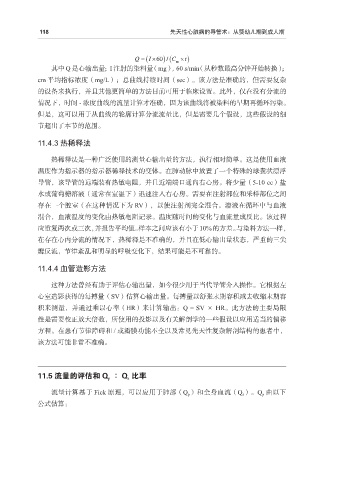
                          describes this relationship:
                                           Q     I       /  C
                                                           t
                                                  60
                                                        m
                 其中 Q 是心输出量;I 注射的染料量(mg),60 s/min(从秒数最高分钟开始转换);
                          where Q is the cardiac output; I the amount of dye injected (mg),
             cm 平均指标浓度(mg/L);总曲线持续时间(sec)。该方法是准确的,但需要复杂
                          60 s/min (as a conversion from seconds top minutes); C m  the mean
                          indicator concentration (mg/l); and t the total curve duration (sec).
             的设备来执行,并且其他更简单的方法目前可用于临床设置。此外,仅在没有分流的
                          The method is accurate but requires complex equipment to per-
             情况下,时间 - 浓度曲线的流量计算才准确,因为该曲线将被染料的早期再循环污染。
                          form, and other simpler methods are presently available for the
                          clinical  setting.  Additionally,  the  calculation  of  flow  from  the
             但是,这可以用于从曲线的轮廓计算分流流量比,但是需要几个假设,这些假设的细
                          time-concentration curve is only accurate in the absence of shunt-
             节超出了本节的范围。
                          ing, where the curve will become contaminated by early recircu-
                          lation of dye. This can, however, be used to calculate shunt flow
                          ratios from the contour of the curve, but requires several assump-
             11.4.3 热稀释法
                          tions, the details of which are beyond the scope of this section.
                 热稀释法是一种广泛使用的测量心输出量的方法,执行相对简单。这是使用血液
                          11.4.3   Thermodilution Method
             温度作为指示器的指示器稀释技术的变体。在肺动脉中放置了一个特殊的球囊状漂浮
             导管,该导管的远端装有热敏电阻,并且近端端口通向右心房。将少量(5-10 cc)盐
                          Thermodilution is a widely used method to measure cardiac out-
             水或葡萄糖溶液(通常在室温下)迅速注入右心房。需要在注射部位和采样部位之间
                          put and is relatively simple to perform. It is a variation of the
                          indicator-dilution technique using blood temperature as the indi-
             存在一个腔室(在这种情况下为 RV),以使注射剂完全混合。溶液在循环中与血液
                          cator. A special balloon-tipped floatation catheter is placed in the
             混合,血液温度的变化由热敏电阻记录。温度随时间的变化与血流量成反比。该过程
                          pulmonary artery which has a thermistor mounted on its distal end
                          and a proximal port opening into the right atrium. A small amount
             应重复两次或三次,并报告平均值。样本之间应该有小于10%的方差。与染料方法一样,
                          (5–10 cc) of a saline or dextrose solution, usually room tempera-
             在存在心内分流的情况下,热稀释是不准确的,并且在低心输出量状态,严重的三尖
                          ture, is injected rapidly into the right atrium. A chamber (in this
                          case the RV) is required to be present between the injection site
             瓣反流,节律紊乱和明显的呼吸变化下,结果可能是不可靠的。
                          and sampling site to allow complete mixing of the injectate. The
             11.4.4 血管造影方法
                 这种方法曾经有助于评估心输出量,如今很少用于当代导管介入操作。它根据左

             心室造影获得的每搏量(SV)估算心输出量。每搏量以舒张末期容积减去收缩末期容
             积来测量,并通过乘以心率(HR)来计算输出:Q = SV × HR。此方法的主要局限
             性是需要校正放大倍数,所使用的投影以及有关解剖学的一些假设以应用适当的偏移
             方程。在患有节律障碍和 / 或瓣膜功能不全以及常见先天性复杂解剖结构的患者中,
             该方法可能非常不准确。


             11.5 流量的评估和 Q p ∶Q s 比率

                 流量计算基于 Fick 原理,可以应用于肺部(Q p )和全身血流(Q s )。Q p 由以下
             公式估算:

