Page 135 - 先天性心脏病的导管术:从婴幼儿期到成人期
P. 135

J. P. S. Jones and L. N. Benson
                                 168
                                                                 J. P. S. Jones and L. N. Benson
                                 168

                                                                          l
                                          2
                                                  l
                                                     Oxygen capacity mlO /
                                      CO mlO /
                                               2
                                                                        2
                                        v
                                          2

                                                                          l  %%
                                                  l
                                                     Oxygen capacity mlO /
                                      CO mlO /

                                                       venous oxygensaturation
                                               2
                                        v
                                                                        2


                                                       venous oxygensaturation %%


                                   For example, if the Hgb was 140 g/l, venous saturation 70%,
                                 the oxygen capacity would be 140 g/l × 1.39 = 194.6 ml O 2 /l. The
                                   For example, if the Hgb was 140 g/l, venous saturation 70%,
                                 oxygen content would be 0.70 × 194.6 = 136.22 ml O 2 /l.
                                 the oxygen capacity would be 140 g/l × 1.39 = 194.6 ml O 2 /l. The
                                 oxygen content would be 0.70 × 194.6 = 136.22 ml O 2 /l.
                                   If the patient is breathing enriched oxygen (F I O 2  > 30%), the
                                 amount  of  dissolved  oxygen  becomes  significant  and  must  be
                                   If the patient is breathing enriched oxygen (F I O 2  > 30%), the
                                 amount  of  dissolved  oxygen  becomes  significant  and  must  be
                                 accounted for in the flow equation. At body temperature, there is
                                 accounted for in the flow equation. At body temperature, there is
                                 0.000032 ml of O 2  per 1 ml of plasma at a partial pressure of oxy-
                                 gen  of  1  mmHg.  Thus,  the  solubility  coefficient  of  oxygen
                                 0.000032 ml of O 2  per 1 ml of plasma at a partial pressure of oxy- in
                                 plasma is 0.00003 O 2  ml/ml plasma/mmHg O 2  tension. Therefore,
                                 gen  of  1  mmHg.  Thus,  the  solubility  coefficient  of  oxygen  in
                                 plasma is 0.00003 O 2  ml/ml plasma/mmHg O 2  tension. Therefore,
                                 the amount of dissolved oxygen in 1 l of plasma is 0.032 per P x O 2
                    11 血液动力学评估:压力,流速,阻力和血管反应性实验                                               117
                                 of the sample and has to be added to the equation above as
                                 the amount of dissolved oxygen in 1 l of plasma is 0.032 per P x O 2
                                 of the sample and has to be added to the equation above as
                                    CO    oxygen capacity arterial oxygensaturation
                                                                                %
                                       2
                                     a
                                    CO    oxygen capacity arterial oxygensaturation   PO mmmHg   (%)
                                                                                %
                                                             2

                                                    0 032 .
                                                           a
                                     a  2            0 032 .  PO mmmHg
                                                             2
                                                           a

                                    CO    oxygen capacity venous oxygensaturation   (%)
                                                                                %
                                       2
                                     v
                                    CO    oxygen capacity venous oxygensaturation

                                                            2
                                                         PO mmHHg
                                                                                %

                                                   0 032 .
                                     v
                                       2
                                                          v
                                                         PO mmHHg
                                                            2

                                                   0 032 .
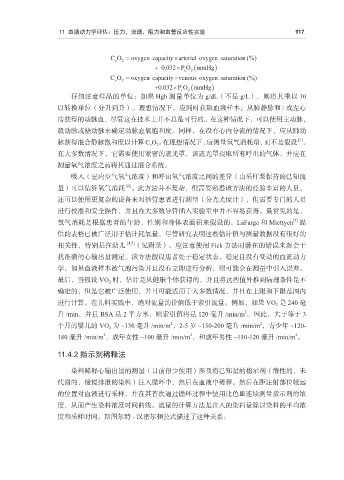
                       仔细注意样品的单位;如果 Hgb 测量单位为 g/dL(不是 g/L),则将其乘以 10


                                                          v
                                   Note carefully the units of the samples; if Hgb is measured as
                   以转换单位(分升到升)。理想情况下,应同时获取血液样本;从肺静脉和 / 或左心
                                 g/dl (not g/l), then it is multiplied by 10 to convert the units (deci-
                                   Note carefully the units of the samples; if Hgb is measured as
                                 g/dl (not g/l), then it is multiplied by 10 to convert the units (deci-
                   房获得的动脉血,尽管这在技术上并不总是可行的。在这种情况下,可以使用主动脉,
                                 liters to liters).
                                 liters to liters).blood samples should be obtained simultaneously;
                                   Ideally, the
                   股动脉或桡动脉来确定动脉血氧饱和度。同样,在没有心内分流的情况下,应从肺动
                                   Ideally, the blood samples should be obtained simultaneously;
                                 the arterial blood obtained from the pulmonary vein and/or left
                                                                                               [1]
                                 atrium, although this is not always technically feasible. In this
                                 the arterial blood obtained from the pulmonary vein and/or left
                   脉获得混合静脉饱和度以计算C v O 2 。在理想情况下,应测量氧气消耗量,而不是假设 。
                                 case, either the aortic, femoral, or radial artery can be used to
                                 atrium, although this is not always technically feasible. In this
                   在大多数情况下,它需要使用紧密的遮光罩,该遮光罩提取所有呼出的气体,并应在
                                 case, either the aortic, femoral, or radial artery can be used to
                                 determine arterial oxygen saturation. Similarly, a mixed venous
                                 saturation to calculate C v O 2  should be obtained from the pulmo-
                                 determine arterial oxygen saturation. Similarly, a mixed venous
                   测量氧气浓度之前将其通过混合系统。
                                 nary artery in the absence of an intracardiac shunt. In the ideal
                                 saturation to calculate C v O 2  should be obtained from the pulmo-
                       吸入(室内空气氧气浓度)和呼出氧气浓度之间的差异(由采样泵保持的已知流
                                 nary artery in the absence of an intracardiac shunt. In the ideal
                                 setting,  oxygen  consumption  should  be  measured  rather  than
                                         [2]
                   量)可以估算氧气消耗 。此方法并不复杂,但需要熟悉该方法的经验丰富的人员。
                                 assumed [1]. It requires in most instances the use of a tight fitting
                                 setting,  oxygen  consumption  should  be  measured  rather  than
                                 assumed [1]. It requires in most instances the use of a tight fitting
                                 hood that extracts all exhaled gas and passes it through a mixing
                   还可以使用更复杂的设备来对插管患者进行测量(分光光度计),但需要专门的人员
                                 hood that extracts all exhaled gas and passes it through a mixing
                                 system before measuring the concentration of oxygen. The differ-
                                 ence  between  inhaled  (room  air  oxygen  concentration)  and
                   进行校准和安全操作,并且在大多数导管插入实验室中并不容易获得。最常见的是,
                                 system before measuring the concentration of oxygen. The differ-
                                 ence  between  inhaled  (room  air  oxygen  concentration)  and
                                                                                             [3]
                   氧气消耗是根据患者的年龄,性别和身体表面积来假设的。LaFarge 和 Miettyen 提
                   供的表格已被广泛用于估计耗氧量,尽管研究表明这些估计值与测量数据没有很好的
                   相关性,特别是在幼儿            [4,5] (见附录)。应注意使用 Fick 方法时潜在的错误来源会干
                   扰准确的心输出量测定。该方法假设患者处于稳定状态,稳定且没有变动的血流动力
                   学。如果血液样本被气泡污染并且没有立即进行分析,则可能会在测量中引入误差。
                   最后,当假设 VO 2 时,估计是从健康个体获得的,并且将这些值外推到病理条件是不
                   确定的,但是它被广泛使用,并且可能适用于大多数情况,并且在上限和下限范围内
                   进行计算。在儿科实践中,绝对流量的价值低于索引流量。例如,如果 VO 2 是 240 毫
                                                                              2
                   升 /min,并且 BSA 是 2 平方米,则索引值将是 120 毫升 /min/m 。因此,大于等于 3
                                                       2
                                                                                   2
                   个月的婴儿的 VO 2 为 ~130 毫升 /min/m ,2-5 岁 ~150-200 毫升 /min/m ,青少年 ~120-
                                  2
                                                                                              2
                                                             2
                   180 毫升 /min/m ,成年女性 ~100 毫升 /min/m ,和成年男性 ~110-120 毫升 /min/m 。
                   11.4.2 指示剂稀释法
                       染料稀释心输出量的测量(目前很少使用)涉及将已知量的指示剂(惰性的,未
                   代谢的,缓慢排泄的染料)注入循环中,然后在血液中稀释。然后在距注射部位较远
                   的位置对血液进行采样,并在其首次通过循环过程中使用比色皿连续测量指示剂的浓
                   度,从而产生染料浓度时间曲线。流量的计算方法是注入的染料量除以染料的平均浓
                   度和采样时间。斯图尔特 - 汉密尔顿公式描述了这种关系:
   130   131   132   133   134   135   136   137   138   139   140