


Page 134 - 先天性心脏病的导管术:从婴幼儿期到成人期
P. 134
116 先天性心脏病的导管术:从婴幼儿期到成人期
11 Hemodynamic Assessment: Pressures, Flow, Resistances… 167
The Fick equation relates cardiac output to oxygen consump-
tion and blood oxygen content and can be expressed as follows:
简单,观察到流量与血液中某些指标(在这种情况下为氧气)在进入和离开器官(在
167
11 Hemodynamic Assessment: Pressures, Flow, Resistances…
这种情况下为肺部)时的浓度差异成正比。心输出量可以根据血液进入肺前和离开肺
VOmlO / min /
Q l / min
arterialOcontent
The Fick equation relates cardiac output to oxygen consump-
2
2
2
l
后的血氧浓度差异以及氧气的消耗速率来确定,并在导管实验室中广泛用于心输出量
venousOcontentmlOO /
tion and blood oxygen content and can be expressed as follows:
2
2
的评估。假设没有心内分流,并且肺血流等于全身血流。通过从肺动脉(低氧含量)
VOmlO / min /
Q l / min
where Q is cardiac output expressed in liters per minute (l/min)
arterialOcontent
2
2
2
和肺静脉(高氧含量)的血液采样来获得血液动脉和静脉氧含量的测量。外周动脉血
l
and VO 2 is the oxygen consumption in ml O 2 /min. The denomina-
venousOcontentmlOO /
2
2
tor of the Fick equation is the arteriovenous oxygen content dif-
11 Hemodynamic Assessment: Pressures, Flow, Resistances…
167
的采样通常用作肺静脉血的替代品。氧气消耗量的确定更为复杂,但直接测量值优于
ference (AV O 2 ) and is expressed as ml O 2 /l of blood. This
where Q is cardiac output expressed in liters per minute (l/min)
现有表格中的假定氧气消耗量。
The Fick equation relates cardiac output to oxygen consump-
difference is calculated from the arterial (C a O 2 ) and venous oxy-
and VO 2 is the oxygen consumption in ml O 2 /min. The denomina-
tion and blood oxygen content and can be expressed as follows:
gen (C v O 2 ) contents. The calculation of arterial and venous oxy-
tor of the Fick equation is the arteriovenous oxygen content dif-
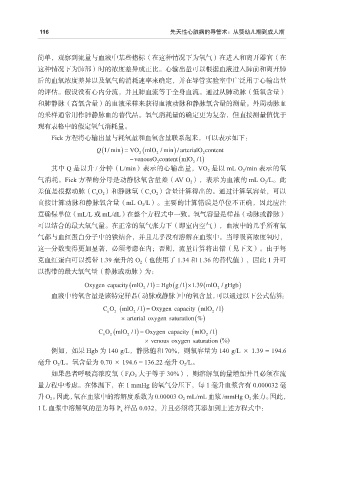
Fick 方程将心输出量与耗氧量和血氧含量联系起来,可以表示如下:
gen content (ml O 2 /l) is straightforward, by calculating the oxygen
ference (AV O 2 ) and is expressed as ml O 2 /l of blood. This
VOmlO / min /
arterialOcontent
capacity.
A major
Q l / min calculation error is incorrect units, so one
difference is calculated from the arterial (C aO 2) and venous oxy-
2
2
2
l
should take care to assure that the units (ml/l or ml/dl) are consis-
venousOcontentmlOO /
gen (C v O 2 ) contents. The calculation of arterial and venous oxy-
2
2
tent throughout the equation. The oxygen capacity is the maxi-
其中 Q 是以升 / 分钟(L/min)表示的心输出量,VO 2 是以 mL O 2 /min 表示的氧
gen content (ml O 2 /l) is straightforward, by calculating the oxygen
mum amount of oxygen that sample (either arterial or venous) can
where Q is cardiac output expressed in liters per minute (l/min)
capacity. A major calculation error is incorrect units, so one
气消耗。Fick 方程的分母是动静脉氧含量差(AV O 2 ),表示为血液的 mL O 2 /L。此
bind. At normal oxygen tensions (i.e., room air), almost all oxy-
and VO 2 is the oxygen consumption in ml O 2 /min. The denomina-
should take care to assure that the units (ml/l or ml/dl) are consis-
gen in the blood is bound to the iron in the hemoglobin molecule
tor of the Fick equation is the arteriovenous oxygen content dif-
差值是根据动脉(C a O 2 )和静脉氧(C v O 2 )含量计算得出的。通过计算氧容量,可以
tent throughout the equation. The oxygen capacity is the maxi-
and very little dissolved in the plasma. When breathing enriched
ference (AV O 2 ) and is expressed as ml O 2 /l of blood. This
mum amount of oxygen that sample (either arterial or venous) can
直接计算动脉和静脉氧含量(mL O 2 /L)。主要的计算错误是单位不正确,因此应注
oxygen, this fraction becomes more significant and must be taken
difference is calculated from the arterial (C a O 2 ) and venous oxy-
bind. At normal oxygen tensions (i.e., room air), almost all oxy-
into account; otherwise, the flow calculation will be in error (see
gen (C v O 2 ) contents. The calculation of arterial and venous oxy-
意确保单位(mL/L 或 mL/dL)在整个方程式中一致。氧气容量是样品(动脉或静脉)
gen in the blood is bound to the iron in the hemoglobin molecule
gen content (ml O 2 /l) is straightforward, by calculating the oxygen O 2
below). As each gram of hemoglobin can carry 1.39 ml of
and very little dissolved in the plasma. When breathing enriched
可以结合的最大氧气量。在正常的氧气张力下(即室内空气),血液中的几乎所有氧
(alternative values of 1.34 and 1.36 have also been used), the max-
capacity. A major calculation error is incorrect units, so one
oxygen, this fraction becomes more significant and must be taken
imal amount of oxygen that can be carried (either venous or arte-
should take care to assure that the units (ml/l or ml/dl) are consis-
气都与血红蛋白分子中的铁结合,并且几乎没有溶解在血浆中。当呼吸高浓度氧时,
into account; otherwise, the flow calculation will be in error (see
rial) in 1 liter is
below). As each gram of hemoglobin can carry 1.39 ml of
tent throughout the equation. The oxygen capacity is the maxi- O 2
这一分数变得更加显著,必须考虑在内;否则,流量计算将出错(见下文)。由于每
mum amount of oxygen that sample (either arterial or venous) can
(alternative values of 1.34 and 1.36 have also been used), the max-
gHgb
139.
Hgbg l/
l
bind. At normal oxygen tensions (i.e., room air), almost all oxy-
mlO /
Oxygen capacity mlO /
克血红蛋白可以携带 1.39 毫升的 O 2 (也使用了 1.34 和 1.36 的替代值),因此 1 升可
imal amount of oxygen that can be carried (either venous or arte-
2
2
gen in the blood is bound to the iron in the hemoglobin molecule
rial) in 1 liter is
以携带的最大氧气量(静脉或动脉)为:
and very little dissolved in the plasma. When breathing enriched
The oxygen content of the blood is the amount of oxygen in
oxygen, this fraction becomes more significant and must be taken
gHgb
139.
that specific sample (either arterial or venous) and can be esti-
Hgbg l/
l
Oxygen capacity mlO /
mlO /
2
2
into account; otherwise, the flow calculation will be in error (see
mated by the following formula:
血液中的氧含量是该特定样品(动脉或静脉)中的氧含量,可以通过以下公式估算:
below). As each gram of hemoglobin can carry 1.39 ml of O 2
The oxygen content of the blood is the amount of oxygen in
(alternative values of 1.34 and 1.36 have also been used), the max-
CO
l
l
that specific sample (either arterial or venous) and can be esti-
Oxygen capacity mlO /
mlO /
2
2
a
imal amount of oxygen that can be carried (either venous or arte-
2
168
J. P. S. Jones and L. N. Benson
mated by the following formula:
rial) in 1 liter is arterial oxygensaturatioon %
2
CO mlO / l Oxygen capacity mlO / l l
CO
l
Oxygen capacity mlO /
mlO /
2
2
v
Oxygen capacity mlO / l Hgbg l / 139. mlO / gHgb
2
2
2
a
venous oxygensaturation %%
arterial oxygensaturatioon % 2 (%)
2
例如,如果 Hgb 为 140 g/L,静脉饱和 70%,则氧容量为 140 g/L × 1.39 = 194.6
The oxygen content of the blood is the amount of oxygen in
For example, if the Hgb was 140 g/l, venous saturation 70%,
that specific sample (either arterial or venous) and can be esti-
毫升 O 2 /L。氧含量为 0.70 × 194.6 = 136.22 毫升 O 2 /L。
the oxygen capacity would be 140 g/l × 1.39 = 194.6 ml O 2 /l. The
mated by the following formula:
oxygen content would be 0.70 × 194.6 = 136.22 ml O 2 /l.
如果患者呼吸高浓度氧(F I O 2 大于等于 30%),则溶解氧的量增加并且必须在流
If the patient is breathing enriched oxygen (F I O 2 > 30%), the
CO
l
量方程中考虑。在体温下,在 1 mmHg Oxygen capacity mlO /and must be
l 的氧气分压下,每 1
mlO / oxygen becomes significant 毫升血浆含有 0.000032 毫
amount of dissolved
2
a
2
2
accounted for in the flow equation. At body temperature, there is
升 O 2 。因此,氧在血浆中的溶解度系数为 0.00003 O 2 mL/mL
arterial oxygensaturatioon % 血浆 /mmHg O 2 张力。因此,
0.000032 ml of O 2 per 1 ml of plasma at a partial pressure of oxy-
1 L 血浆中溶解氧的量为每 P x 样品 0.032,并且必须将其添加到上述方程式中:
gen of 1 mmHg. Thus, the solubility coefficient of oxygen in
plasma is 0.00003 O 2 ml/ml plasma/mmHg O 2 tension. Therefore,
the amount of dissolved oxygen in 1 l of plasma is 0.032 per P x O 2
of the sample and has to be added to the equation above as
CO oxygen capacity arterial oxygensaturation
%
a
2
2
0 032 . PO mmmHg
a
CO oxygen capacity venous oxygensaturation
%
v
2
2
0 032 . PO mmHHg
v
Note carefully the units of the samples; if Hgb is measured as
g/dl (not g/l), then it is multiplied by 10 to convert the units (deci-
liters to liters).
Ideally, the blood samples should be obtained simultaneously;
the arterial blood obtained from the pulmonary vein and/or left
atrium, although this is not always technically feasible. In this
case, either the aortic, femoral, or radial artery can be used to
determine arterial oxygen saturation. Similarly, a mixed venous
saturation to calculate C v O 2 should be obtained from the pulmo-
nary artery in the absence of an intracardiac shunt. In the ideal
setting, oxygen consumption should be measured rather than
assumed [1]. It requires in most instances the use of a tight fitting
hood that extracts all exhaled gas and passes it through a mixing
system before measuring the concentration of oxygen. The differ-
ence between inhaled (room air oxygen concentration) and

