


Page 137 - 先天性心脏病的导管术:从婴幼儿期到成人期
P. 137
11 Hemodynamic Assessment: Pressures, Flow, Resistances…
solution mixes with blood in the circulation, and the change in
blood temperature is recorded by the thermistor. This change in
temperature over time is inversely proportional to the blood flow.
The procedure should be repeated two or three times and averaged
values reported. There should be less than a 10% variance between
samples. As in the dye method, thermodilution is inaccurate in the
presence of intracardiac shunts, and results may be unreliable in
low cardiac output states, severe tricuspid regurgitation, rhythm
disturbances, and significant respiratory variations.
11.4.4 Angiographic Method
This method, once helpful in cardiac output assessment, is seldom
used to in contemporary catheterization today. It estimates cardiac
output from the stroke volume (SV) obtained from a left ventricu-
logram. The stroke volume is measured as the end-diastolic vol-
ume minus the end-systolic volume, and the output is calculated
by multiplying by the heart rate (HR): Q = SV × HR. The main
limitation of this method is the requirement to correct for magni-
fication, the projection used, and some assumptions regarding
anatomy to apply the appropriate offset equations. In patients with
rhythm disturbances and/or valvular insufficiency, and the com-
plex anatomy common in congenital lesions, the method can be
very inaccurate.
11.5 Assessment of Flows and the Q p :Q s Ratio 171
172 172 J. P. S. Jones and L. N. BensonJ. P. S. Jones and L. N. Benson
Flow calculations are based on Fick’s principle and can be applied
Similarly Q s is estimated asSimilarly Q s is estimated as
11 血液动力学评估:压力,流速,阻力和血管反应性实验 119
to both pulmonary (Q p ) and systemic blood flows (Q s ). Q p can be
estimated by the following equation: systemic arterial Ocontent
systemic arterial Ocontent
172 Q VO / Q VO / J. P. S. Jones and L. N. Benson
2
2
s 2 mixed venous Ocontentmixed venous Ocontent
2
s
172 Similarly Q pulmonary venous Ocontent 2
2
J. P. S. Jones and L. N. Benson
Q s is estimated as
2
VO /
2
Finally, effective pulmonary blood flow (Q ep ) is the amount of ) is the amount of
p
pulmonary arterial Ocontent
Finally, effective pulmonary blood flow (Q ep
2
deoxygenated blood that is pumped to the lungs.deoxygenated blood that is pumped to the lungs.
Similarly Q s is estimated as
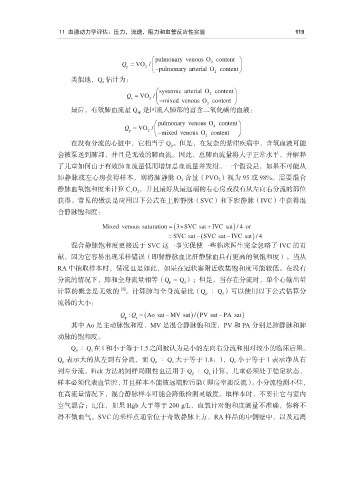
类似地,Q s 估计为: systemic arterial Ocontent
2
Q VO /
s 2 mixed venous Ocontent
pulmonary venous Ocontentpulmonary venous Ocontent
Q Q VO VO / Q VO / 2 2 2 2
systemic arterial Ocontent
/
2
2
p
mixedvenous Ocontentmixedvenous Ocontent
2
p
s
Finally, effective pulmonary blood flow (Q ep ) is the amount of
mixed venous Ocontent
2 2 2
deoxygenated blood that is pumped to the lungs.
最后,有效肺血流量 Q ep 是回流入肺部的富含二氧化碳的血液:
In a biventricular heart with no shunting, it is equivalent to Q p .
In a biventricular heart with no shunting, it is equivalent to Q p .
Finally, effective pulmonary blood flow (Q ep ) is the amount of
However, in complex cyanotic disease, oxygenated blood may be However, in complex cyanotic disease, oxygenated blood may be
deoxygenated blood that is pumped to the lungs.
pulmonary venous Ocontent
pumped to the lungs and is ineffective pulmonary blood flow. As pumped to the lungs and is ineffective pulmonary blood flow. As
Q
2
VO /
p
2
mixedvenous Ocontent
such, the total pulmonary blood flow will be greater than normal such, the total pulmonary blood flow will be greater than normal
pulmonary venous Ocontent
2
2
Q
VO /
and explains how a child can have an increased total blood flow and explains how a child can have an increased total blood flow
在没有分流的心脏中,它相当于 Q p 。但是,在复杂的紫绀疾病中,含氧血液可能
p
2
In a biventricular heart with no shunting, it is equivalent to Q p .
mixedvenous Ocontent
and be cyanotic due to low effective pulmonary blood flows.and be cyanotic due to low effective pulmonary blood flows.
2
However, in complex cyanotic disease, oxygenated blood may be
会被泵送到肺部,并且是无效的肺血流。因此,总肺血流量将大于正常水平,并解释
In a biventricular heart with no shunting, it is equivalent to Q p .
A fair assumption is to consider pulmonary venous O 2 content
A fair assumption is to consider pulmonary venous O 2 content
pumped to the lungs and is ineffective pulmonary blood flow. As
However, in complex cyanotic disease, oxygenated blood may be
(PVO 2 ) as 95 or 98% if obtaining a sample from the pulmonary (PVO 2 ) as 95 or 98% if obtaining a sample from the pulmonary
了儿童如何由于有效肺血流量低而增加总血流量并发绀。一个假设是,如果不可能从
such, the total pulmonary blood flow will be greater than normal
pumped to the lungs and is ineffective pulmonary blood flow. As
vein or the left atrium is not possible. A mixed venous oxygen vein or the left atrium is not possible. A mixed venous oxygen
and explains how a child can have an increased total blood flow
肺静脉或左心房获得样本,则将肺静脉 O 2 含量(PVO 2 )视为 95 或 98%。需要混合
such, the total pulmonary blood flow will be greater than normal
saturation is needed to calculate C v O 2 and best obtained from the saturation is needed to calculate C v O 2 and best obtained from the
and be cyanotic due to low effective pulmonary blood flows.
and explains how a child can have an increased total blood flow
most distal right heart chamber or site where there is no left-to- most distal right heart chamber or site where there is no left-to-
静脉血氧饱和度来计算 C v O 2 ,并且最好从最远端的右心房或没有从左向右分流的部位
A fair assumption is to consider pulmonary venous O 2 content
right shunt. A common practice is to obtain mixed venous satura-right shunt. A common practice is to obtain mixed venous satura-
and be cyanotic due to low effective pulmonary blood flows.
(PVO 2 ) as 95 or 98% if obtaining a sample from the pulmonary
获得。常见的做法是应用以下公式在上腔静脉(SVC)和下腔静脉(IVC)中获得混
A fair assumption is to consider pulmonary venous O 2 content
tion in the superior vena cava (SVC) and the inferior vena cava tion in the superior vena cava (SVC) and the inferior vena cava
vein or the left atrium is not possible. A mixed venous oxygen
(PVO 2 ) as 95 or 98% if obtaining a sample from the pulmonary
(IVC) applying the following formula:(IVC) applying the following formula:
合静脉饱和度:
saturation is needed to calculate C v O 2 and best obtained from the
vein or the left atrium is not possible. A mixed venous oxygen
most distal right heart chamber or site where there is no left-to-
SVC satIVC sat
or
Mixedvenous saturation 3 saturation
saturation is needed to calculate C v O 2 and best obtained from the sat 3 SVC 4/satIVC 4/ or
Mixedvenous
right shunt. A common practice is to obtain mixed venous satura-
most distal right heart chamber or site where there is no left-to-
SVCsat
SVCsat IIVCsat /4SVCsat
tion in the superior vena cava (SVC) and the inferior vena cava
SVCsat IIVCsat /4
right shunt. A common practice is to obtain mixed venous satura-
(IVC) applying the following formula:
混合静脉饱和度更接近于 SVC 这一事实促使一些临床医生完全忽略了 IVC 的贡
The fact that mixed venous saturation more closely approxi-The fact that mixed venous saturation more closely approxi-
tion in the superior vena cava (SVC) and the inferior vena cava
mates the SVC has encouraged some clinicians to disregard con-mates the SVC has encouraged some clinicians to disregard con-
献,因为它容易出现采样错误(即肾静脉血比肝静脉血具有更高的氧饱和度)。当从
(IVC) applying the following formula:
SVC satIVC sat
4/
Mixedvenous saturation 3
or
tribution from the IVC completely as it is prone to sampling errors tribution from the IVC completely as it is prone to sampling errors
173
11 Hemodynamic Assessment: Pressures, Flow, Resistances…
SVCsat
RA 中抽取样本时,情况也是如此,如果在冠状窦附近收集饱和度可能较低。在没有
SVCsat IIVCsat /4
(i.e., the renal venous blood has a higher oxygen saturation than (i.e., the renal venous blood has a higher oxygen saturation than
SVC satIVC sat
Mixedvenous saturation 3
4/
or
single cardiac output calculation is invalid when shunting is pres-
does hepatic venous blood). The same applies when samples are does hepatic venous blood). The same applies when samples are
分流的情况下,肺和全身流量相等(Q SVCsat IIVCsat /4 closely approxi-
SVCsat p = Q s );但是,当存在分流时,单个心输出量
mixed venous saturation more
The fact that
ent [6]. Calculation of the pulmonary to systemic flow ratio
drawn from the RA where saturation could be low if collected drawn from the RA where saturation could be low if collected
mates the SVC has encouraged some clinicians to disregard con-
[6]
计算的概念是无效的 。计算肺与全身流量比(Q p ∶ Q s )可以使用以下公式估算分
(Q p :Q s ) can estimate the magnitude of shunts using the following
near the coronary sinus. In the absence of a shunt, pulmonary and near the coronary sinus. In the absence of a shunt, pulmonary and
The fact that mixed venous saturation more closely approxi-
tribution from the IVC completely as it is prone to sampling errors
equation:
systemic flows are equal (Q p = Q s ); however, the concept of a = Q s ); however, the
流器的大小: mates the SVC has encouraged some clinicians to disregard con-concept of a
(i.e., the renal venous blood has a higher oxygen saturation than
systemic flows are equal (Q p
tribution from the IVC completely as it is prone to sampling errors
does hepatic venous blood). The same applies when samples are
Q
PV satPAsat
Ao satMVsat /
Q :
(i.e., the renal venous blood has a higher oxygen saturation than
drawn from the RA where saturation could be low if collected
s
p
does hepatic venous blood). The same applies when samples are
其中 Ao 是主动脉饱和度,MV 是混合静脉饱和度,PV 和 PA 分别是肺静脉和肺
near the coronary sinus. In the absence of a shunt, pulmonary and
where Ao is the aortic saturation, MV the mixed venous satura-
drawn from the RA where saturation could be low if collected
systemic flows are equal (Q p = Q s ); however, the concept of a
tion, and PV and PA saturations of the pulmonary vein and artery,
动脉的饱和度。
near the coronary sinus. In the absence of a shunt, pulmonary and
respectively.
systemic flows are equal (Q p = Q s ); however, the concept of a
Q p ∶Q s 在1和小于等于1.5之间被认为是小的左向右分流和相对较小的临床后果。
A Q p :Q s between 1 and < 1.5 is considered a small left-to-right
Q p 表示大的从左到右分流,而 Q p ∶ Q s 大于等于 1.8:1,Q s 小于等于
shunt and of relatively small clinical consequence. A Q p :Q s > 1.8:1 1 表示净从右
indicates a large left-to-right shunt, while a Q p :Q s < 1 indicates a
到左分流。Fick 方法的同样局限性也适用于 Q p ∶ Q s 计算。儿童必须处于稳定状态,
net right-to-left shunt. The same limitations of the Fick method
样本必须代表血管腔,并且样本不能被远端腔污染(即房室瓣反流)。小分流检测不佳,
apply to Q p :Q s calculations. The child must be in a steady state,
the samples must be representative of the chamber of vessel, and
在高流量情况下,混合静脉样本可能会降低检测灵敏度。取样本时,不要让它与室内
the sample cannot be contaminated by the distal chamber (i.e.,
空气混合;记住,如果 Hgb 大于等于 200 g/L,血氧计对饱和度测量不准确,你将不
atrioventricular valve regurgitation). Small shunts are poorly
detected, and in high-flow situations, the mixed venous sample
得不做血气。SVC 的采样点通常位于奇数静脉上方,RA 样品的中侧壁中,以及远离
may be high reducing the detection sensitivity. When taking the
sample, do not let it equilibrate with room air; remember, oxime-
ters are not accurate for saturation measurements if the Hgb is
>200 g/l, where you will have to then do a blood gas. Sampling
sites for the SVC are generally above the azygous vein, in the
mid-lateral wall for an RA sample, and above the diaphragm for
the IVC away from renal vein flow, which can contaminate the
sample.
In addition to the above flow calculations, assessment of the
efficiency of the heart to deliver oxygen to the tissues can be
determined. Global oxygen delivery (DO 2 ), also known as sys-
temic oxygen transport (SOT), is the amount of oxygen delivered
to the whole body from the lungs. It is the product of total blood
flow or cardiac output (Q s ) and the oxygen content of arterial
blood (C a O 2 ) and is expressed in ml/min: DO 2 = Q s × C a O 2 . The
oxygen extraction ratio (O 2 ER) is the ratio of VO 2 to DO 2 and
represents the fraction of oxygen delivered to the microcirculation
that is taken up by the tissues, O 2 ER = VO 2 /DO 2 . The normal

